Toon stars joined forces to help a Tyneside anti-racism charity gain national recognition.
Whitley Bay-based Show Racism the Red Card wants to be crowned Charity of the Year.
If given the accolade by the Football Association, the organisation would get a huge publicity boost, as well as a share of fundraising carried out by the governing body.
And the Newcastle United team lent their support when the squad took time out from their pre-match preparations at St James’ Park on Sunday to pose for photographs and outline their support for the campaign.
It comes as more than 60 MPs rallied behind the efforts to be named charity of the year.
Bosses of the organisation, founded 14 years ago, want to get the support of 100 MPs and will host a special event in October to encourage as many as possible to sign up.
Those already on board include South Shields MP David Miliband, who narrowly lost out to brother Ed in the Labour leadership election this weekend. It is Mr Miliband’s Blaydon colleague Dave Anderson who has arranged for Show Racism the Red Card chiefs to gain access to the House of Commons on October 19, when they will aim to convince as many people as possible to follow them.
Other MPs to have given their backing so far are Stephen Hepburn, Chi Onwurah, Ian Mearns and Ian Lavery, alongside Sunderland chairman Niall Quinn, Toon manager Chris Hughton and former England Manager Graham Taylor.
And every member of the Magpies squad, along with Wallsend-born Emmerdale actress Charlie Hardwick, herself a Toon fan, posed for snaps holding aloft campaign placards at St James’ Park.
The photo shoot took place ahead of United’s defeat to Stoke City, which saw the Toon take the lead through a Kevin Nolan penalty, before ex-Sunderland striker Kenwyne Jones equalised and James Perch put through his own net to give the Potters the lead in front of the Sky TV cameras.
Ged Grebby, of the charity, said: “We have a great relationship with the club and, as ever, were thankful of their support.
“We hope we can push on now and be named charity of the year, which would mean a great deal to us.”
Chronicle Live

Wednesday, 29 September 2010
Police pledge swifter response to racism and homophobia than 'ordinary' crime

The new hate-crime guidance manual is aimed at instigating a cultural change in policing and, as a result, throughout Scotland.
Police will stress to officers that victims from minorities suffer more when a crime is motivated by prejudice than a member of the general public would from the same offence.
Assistant Chief Constable Mike McCormick, of Lothian and Borders Police, said: "We wanted to make sure our own staff were aware of the impact hate crime has.
"If you punch me in the nose because you don't like me because of the colour of my skin, race, sexuality or whatever, that has a longer effect because I'm thinking that not only does this person not like me, but lots of other people won't like me either.
"If someone is already struggling with a disability then a hate crime can leave them thinking not only do I have a physical problem, but I also have a social problem because people don't like me.
"It has a much more significant effect on victims and I want people to pick up on that.
"If people say 'I had not meant any harm' it was just a bit of loose language, we're saying think hard before you say something. And we want victims of hate crime to know this is how we feel."
The new manual brings together best practice from the various eight Scottish forces that was put in place following the Stephen Lawrence inquiry in 1999.
The inquiry into the murder of the black teenager in 1993 found the Metropolitan Police to be "institutionally racist", a verdict has had repercussions that continue to affect UK policing.
The manual represents a promise to protect, not only ethnic minorities, but anyone who might be prejudiced against because of age, disability, gender including transgender, race including gypsy/travellers, religion or belief, and sexual orientation.
It is backed by new powers in the Offences Aggravated by Prejudice (Scotland) Act, which was passed in Scottish Parliament earlier this year.
Sergeant Martin White, of the diversity unit at Lothian and Borders Police, one of the officers who wrote the manual, said: "(Under the act] if someone is arrested for hate crime, we must look to put them before the courts as soon as possible, if not from custody then bailed to appear as soon as possible.
"In the courts, hate crime has to be recorded and reflected in the sentence. It gives the courts the chance to give an appropriate sentence.
That might mean restorative justice - addressing problems the victim might have within their community."
Mr McCormick added: "If it manifests again the court will take an even dimmer view of a person perpetrating homophobic or racist crimes."
Chief Constable Ian Latimer, chairman of the Acpos equality and diversity business area, said: "The manual, developed in consultation with partner agencies and victim support charities, gathers best practice and provides officers with guidance on how to recognise and investigate hate crime."
Justice secretary Kenny Mac-Askill said: "We live in a modern Scotland where there is no excuse for hate crime of any form. This new Acpos guidance has my full support."
Ros Micklem, National Director Scotland for the Equality and Human Rights Commission, said: "Recognition of the corrosive impact of hate crime upon individuals and communities is clear in this manual, as is the determination to continue to work with communities to provide an effective response."
Scotsman news


Tuesday, 28 September 2010
Jobbik against setting up Tom Lantos Institute (Hungary)

Hungarian President Pal Schmitt told a UN general assembly meeting in New York on Friday that Hungary plans to set up a centre to promote tolerance, to be named after Lantos.
Jobbik parliamentary group leader Marton Gyongyosi said on Monday that the initial idea for the centre came from former Prime Minister Ferenc Gyurcsany, who announced plans to set up a Tom Lantos institute after the US politician's death in February 2008.
Gyongyosi said Lantos, a former politician of the Democratic Party, was a "Hungarophobe" and "best friends" with former Romanian dictator Nicolae Ceausescu.
"Hungarian right-wing people with patriotic feelings will never support this initiative," he said.
In addition to the naming of the institute, Gyongyosi also criticised the entire plan to set up such an organisation, adding that minority research and promoting tolerance were not among Hungary's most urgent tasks at the moment.
Politics Hu
Ukraine holds two over suspected anti-Semitic murder
An Israeli Hasid was stabbed to death and his brother was beaten late Saturday night in Uman, a Breslov pilgrimage destination.
An Israeli Breslov Hassid was stabbed to death and his brother was beaten late Saturday night in the Ukrainian city of Uman. Shmuel Toubul, 20, and his older brother Rafael were in Ukraine to assist Jews making the pilgrimage to the grave of Rebbe Nachman of Breslov.
The three assailants fled the scene but hours later two of them were apprehended by police. Police have yet to decided whether to charge the two with murder or manslaughter.
The victims' family believe the incident was motivated by anti-Semitism. It is also thought that the attack may have been motivated by the Rosh Hashanah killing of a local man by a Jew who fled the country.
The killing of Toubul occurred on the 200th anniversary of the death of Rebbe Nachman.
The Jewish community in Ukraine managed to persuade the police to hand over Toubul's body without performing an autopsy, though one is required by law. Performing an autopsy is a sacrilege to many religious Jews. The body was flown to Israel, and the man was to be laid to rest late last night in Jerusalem.
The stabbing, just after midnight Saturday, occurred a few hundred meters from the rebbe's grave, where Jewish followers had gathered to pay homage and mark 200 years since his passing. The Toubuls, originally from the West Bank settlement of Immanuel, manage a number of businesses in Uman. They own an apartment they rent out, operate a transportation service and a local supermarket offering kosher products to the tens of thousands of Jewish visitors who come annually.
The Toubuls' businesses in Uman are managed by Rafael Toubul, with the younger Shmuel making the trip before Rosh Hashanah to offer help. Shmuel Toubul kept in touch with many Israeli visitors via his Facebook page. He was to be married in Israel in two months.
According to the Toubul family and local Jewish officials in Uman, the memorial ceremony near the rebbe's grave drew dozens of people. Shmuel Toubul was sent to bring refreshments. While he was inside his home, he heard noises outside, where three young men were hurling rocks at his car. He alerted Rafael, who was also home. The two went outside to chase away the stone throwers, who then assaulted the brothers. Rafael Toubul says they tried to defend themselves, they hit back and offered the attackers money to leave them alone. But one of them produced a knife and stabbed Shmuel Toubul three times, including once in the heart. He was rushed to hospital, where he was pronounced dead. Rafael was beaten around the head and feet with an object.
Another brother, Nachman Toubul, said: "Even though my brother Rafael offered the youths money so that they would be left alone, they refused, pulled out a knife, and stabbed Shmuel, of blessed memory, in the heart. Shmuel collapsed on the spot and he called out to his brother, 'Rafael, they stabbed me in the heart.'" He said his brother lost consciousness and then was pronounced dead at the hospital.
Ukrainian police are trying to determine whether the violence was random and whether the suspects involved were under the influence of alcohol. One of the suspects is in his early 30s and the other in his early 20s. They were found to have blood stains on their clothing.
Hareetz
Crime Spree Suspects Linked To White Supremacy Group USA
Authorities believe a group of midstate criminals is responsible for running several meth labs and breaking into homes and cars across the region.
They're armed, dangerous, and now linked to a radical white supremacist group.
Investigators describe them as a loose knit gang, and the Sumner County Sheriff's Department has every intention of shutting this group of criminals down.
What started as a series of car thefts weeks ago led investigators with the Sumner County Sheriff's Department to a series of meth labs and dozens of stolen guns. Child endangerment charges were also filed after a five month old baby was found in the same home as an active meth lab.
"Thefts, burglaries, assaults then the meth labs. we recovered 5 meth labs during this investigation," said Sumner County Sheriff Sonny Weatherford.
Now, the case has taken another turn-- at least 14 people responsible for the crime spree now face criminal charges, and all of them have linked themselves to a white supremacist group known as Aryan Nations.
"They feel they're a dominant race and do the intimidation on the rest of the public," said Weatherford.
Investigators said many of the suspects met each other while in prison. While the network of white supremacists is not tight knit, Sheriff Weatherford said his department is cracking down on the group to prevent future crimes and public unrest.
"If you are in Aryan Nations and in Sumner County we want to locate you and get you out of Sumner County, whether that's by placing you in jail or you leaving," said Weatherford.
Investigators are taking the Aryan Nations group seriously for several reasons. Detectives said they've broken into homes, cars, and stores in five different midstate counties. And, they could be extremely dangerous. Authorities have seized more than 60 guns they believe were stolen during the crime spree. At least one member of the group is still on the loose.
Investigators believe there are more members of Aryan Nations in Sumner County and the surrounding areas who could be part of the rash of crimes. Anyone with information on the case is encouraged to call the Sumner County Sheriff's Department.
News Channel 5
White supremacist sentenced for attack (USA)
Lockner gets 31 years for beating elderly black man
A Baltimore judge sentenced white supremacist Calvin E. Lockner to 31 years in prison Monday on four criminal counts, including the assault of an elderly black fisherman, who repeatedly described the beating and its aftermath as "stressful" during the brief court proceeding.
Standing four feet from his attacker, James Privott, 77, outlined the effects of the August 2009 battering, which left him with a fractured eye socket, missing teeth and expensive doctor bills.
"The situation put my wife and I and my family in a stressful, stressful" position, Privott said. "My wife basically had to take over for me. … For three weeks, I couldn't see."
Court papers describe Lockner, 29, as a Hitler follower and registered sex offender who molested a little girl and raped a woman. He pleaded guilty last week to attacking Privott, as the older man packed up his Chevy Tahoe and prepared to head home after an early morning of fishing at Fort Armistead Park
Motivated by hate, Lockner and two others beat Privott, then stole his vehicle, according to court records. Lockner received a 30-year sentence for the carjacking, 25 years for assaulting Privott and 10 years for committing a hate crime, all set to run concurrently. He received an additional one-year sentence for assaulting a correctional officer by throwing urine at the man, who declined to speak in court Monday.
Lockner's public defender read a statement on his behalf apologizing to Privott and asking for forgiveness.
"I should have been able to conduct myself as a man, but chose the acts of a boy," Lockner said in the statement. "I am sorry for the pain and agony that my actions have caused you."
The trial of a co-defendant, Zachary Watson, 18, had been scheduled Monday but was postponed because Watson's attorney is trying another case, according to the Baltimore state's attorney's office. A third defendant, 16-year-old Emmanuel Miller, was previously found "involved" by a juvenile court judge.
Baltimore Sun
Attacks on homeless becoming hate crimes in Fla (USA)
Prejudice-motivated attacks against homeless people are becoming hate crimes in Florida, a state that has led the nation in that statistic four of the last five years.
The new law goes into effect Friday.
Florida is the largest of five states and the District of Columbia that have increased penalties for attacks against the homeless, but the National Coalition for the Homeless says it's unsure such laws will do any good.
The coalition first wants the federal government to begin collecting data to help determine what will work.
A U.S. Senate Judiciary subcommittee is scheduled to hear testimony on that issue Wednesday.
Other advocates, though, say publicity surrounding hate crime laws can be a deterrent itself.
Miami Herald
FRANCE’S NATIONAL FRONT STEADILY GAINING STRENGTH, POLLS SHOW
Tall, blonde and plain-spoken, 42-year-old Marine Le Pen has two ambitions: to succeed her father, Jean-Marie Le Pen, when he steps down as head of the extreme right National Front party in January, and to become the first French president who represents the far right. But even if her succession is still months away, and her ascension to the presidency unlikely, Ms. Le Pen and the National Front are already wielding disproportionate influence on French politics. Observers say that although the party is still far behind in the polls, the National Front’s touch is being felt in everything from President Nicolas Sarkozy’s attack on Roma and other immigrants this summer to a decision earlier this month by a small-town mayor to refuse a group of refugee children the right to go to school. The far right has always had some influence in France, but a possible surge in popularity for the National Front is causing extra concern, since it comes at the same time as other extreme right parties improve their standing in Europe. This week, voters in Sweden – the European bastion of social democracy – elected members of an anti-immigrant party to their parliament for the first time. Far-right anti-immigrant parties have also made huge gains in the Netherlands, Norway, Italy and Hungary in recent months.
In France, the latest polls show that the National Front has been steadily gaining popularity and its leader would place third in a crowded roster of candidates to become the next president. Brice Tenturier, who heads the IPSOS polling company, says part of the resurgence is due to a general sense of insecurity in France after the global economic crisis and the euro crisis this spring. But he says Ms. Le Pen is also largely responsible. Her father made it to the second round in the 2002 presidential elections, but then quickly lost support for his blatantly xenophobic message. Ms. Le Pen, a twice-divorced Catholic, still advocates the party’s core values of French nationalism, Euro-skepticism and hard-core law and order. But she has softened the party’s image and drawn people back by insisting she’s not against foreigners, just illegal immigration, and focusing more on social issues. “Marine Le Pen has managed to build up a lot of credibility as a more moderate politician than her father and established herself as a regular commentator,” says Thomas Klau, of the European Centre for Foreign Relations. “It’s very clear that that is causing a lot of concern for Nicolas Sarkozy.”
With his approval ratings at a career low, his government embroiled in a series of conflict-of-interest scandals, and both the National Front and Socialist parties gaining strength, Mr. Sarkozy decided this summer to appeal to far-right sympathizers by rebuilding his image as a law and order politician. The country heard Mr. Sarkozy’s Sports Minister calling the largely immigrant French national soccer team “mafiosos” who had never escaped the mentality of the suburbs, the Interior Minister calling for elected criminal-court judges who would impose harsher sentences, and Mr. Sarkozy ordering the expulsion of Roma who were in the country illegally and proposing a new law that would strip foreigners of their citizenship for committing serious crimes. Some human-rights activists believe Mr. Sarkozy’s new far-right stand has even trickled down to a more grassroots level. As an example, they cite the tiny Parisian suburb of Saint Gratien where the mayor refused to let a group of refugee children attend nursery school and banned their older siblings from school canteens and after-class programs. The mayor, a member of Mr. Sarkozy’s UMP party, said she could not see why local residents should “pay for these children” and cited a more “general problem surrounding asylum seekers.”
Manuel Alvarez, local president of the Federation of Public Schools Parents Association, said the mayor’s actions were illegal and amount to “manifest discrimination” inspired by Mr. Sarkozy’s move to the right. “All summer our President promoted anti-immigrant policies,” he said. “What’s sure is that when you hear Mr. Sarkozy talk that way, it’s going to encourage others in the same sense.” Mr. Tenturier, the pollster, says Mr. Sarkozy’s new position is a gamble, since he risks losing even more support from his traditional base on the centre right. But with the ascent of far-right movements across Europe and in the United States, he has decided it’s worth the risk. “The success of the far right in Sweden, of the Tea Party movement in the United States, all show there is apparently a deep popular discontent and a readiness to vote for parties who draw their success on the protest vote,” Mr. Klau said. “Sarkozy and his advisers surely have that in mind.”
Globe and Mail
NEO-NAZI VULGARITIES INCREASE IN MAINSTREAM CZECH MEDIA (Commentary)
Gradually and stealthily, the rhetoric normally used by neo-Nazis is slowly starting to make its way into serious media in the Czech Republic. We have already grown used to seeing young Roma referred to on neo-Nazi websites as “litters of Gypsies”, blacks referred to as “niggers”, and to various slurs being made against Jewish and Vietnamese people. Today the Czech internet daily Deník.cz and its Havíøov edition, havirovsky.denik.cz, have crossed way over the line. An article on the problems of children hospitalized with jaundice in Havíøov has appeared under the truly eye-catching headline: “Havíøov infection unit full once again of Gypsy litter with jaundice” (“Havíøovská infekce je zase plná malých cikáòat se žloutenkou”). A similar headline ran over the same article on the nationwide Deník.cz server but was changed after about two hours to “Havíøov infection unit is full of Roma children again”. This is the culmination of a gradual vulgarization of Czech society as a whole. Serious political parties (e.g., the Czech Social Democrats) play the nationality card during elections while others (the Civic Democrats) say they want to create a concentration camp for homeless people outside of Prague. The Zemanite Party for Citizens’ Rights (SPOZ) is fighting against drug addicts instead of against drugs, and the Czech Interior Minister does not mind that one of his party’s candidate lists (Public Affairs) is led by an extremist former National Party member. As a result of this vulgarization, already last year four monstrous human beings set fire to a home with children in it (of course, for Havíøovský deník reporter Libor Bìèák, those children were a “Gypsy litter”). If the Havíøovský deník continues this rhetoric, expect to see the following shocking headlines in your paper: “Gooks arrested for growing marijuana”, “Four young men liberated after almost burning a little Gypsy to death”, “Nigger becomes President of the USA”, or “Czech Television presents fourth episode of a documentary series filmed by a litter of young Gypsies”.
Romea
Romea
GYPSY CIRCUS IS NEXT ON FRANCE'S EXPULSION LIST
After deporting many illegal Roma immigrants, Nicolas Sarkozy's government may force Europe's only Gypsy circus to close down
 With its mesmerising songs and startling acrobatics, the Cirque Romanès is one of the most unusual cultural highlights of Paris: the only Gypsy circus in Europe and the only show in the French capital whose artists retreat to their caravans after the curtain falls. For 18 years it has been attracting audiences to its exotic blend of poetry and performance. In June it was deemed good enough to represent France at the World Expo in Shanghai. But after a summer which has seen France crack down on its foreign Roma population and draw the ire of Brussels for the policy, the future of the circus and its loyal band of artists hangs in the balance. The authorities have refused to validate work permits for the five Romanian musicians whose instruments are crucial to the performances. The French employment inspectorate insists that the cancellation of the permits has no connection with the wider political climate, which has seen around 1,000 Roma return to their home countries in nearly two months and around 200 unauthorised Roma camps cleared by police. They say there are problems with the circus's functioning, accuse its owner of underpaying the musicians and question the use of child performers.
Such claims are dismissed as "pure invention" by Alexandre Romanès, the circus's charismatic founder. "They're making up all these reasons. It's complete fantasy," he said, as he sipped coffee outside his caravan on the outskirts of Paris. Responding to the authorities' chief criticism – that of low pay – he added: "They get four times the minimum wage, and they are fed and housed. When I contacted a lawyer and told her what they [the authorities] were trying to claim, she just burst out laughing." Romanès, a published poet and friend of the late writer Jean Genet, is unequivocal about what he believes to be the real reasons for the sudden move, taken for the first time in the circus's two decades of existence. For him, it is just another sign of France's growing hostility towards his people. "As this woman from Luxembourg [EU justice commissioner Viviane Reding] said, we thought Europe was protected from this kind of thing, but clearly it isn't. What I have noticed is that, instead of waging war on poverty, the French government is waging war on the poor," he said.
In order to try to revoke the authorities' "unjust" decision, 59-year-old Romanès and his wife, Délia, have started an online petition. Urging the authorities to let the circus "employ those Romanian and Bulgarian artists with whom they want to work", the appeal has more than 7,000 signatories. A "night of support" on 4 October will aim to rally the troops. One of the most vocal Romanès fans is Reinhard von Nagel, a world-famous harpsichord maker and esteemed Maître d'Art appointed by the French culture ministry. There was no doubt, he said, of the political nature of the refusal of permits. "In France, as in other countries, there are laws for and against things, but they are not always applied. If you want to attack someone, you find a law and you apply it. That is what the authorities are doing in the case of Alexandre and Délia," he said, criticising the "zealousness" of the authorities implementing the "hunting down of the Roma". "It is a policy which I have no hesitation in declaring to be fascist. It bothers me deeply," said Von Nagel, a German who has lived in Paris for decades. At a meeting last weekend with Frédéric Mitterrand, the culture minister, he brought the Cirque Romanès to the minister's attention. "I told him that if the Cirque Romanès is shut, I don't know if I can stay in France," he said.
President Sarkozy's policy of paid "voluntary returns" for all those foreign Roma found to be living on French soil without permission has been denounced as unfair and unworkable by human rights activists, foreign politicians and even members of the president's own right-wing UMP party, one of whom – like Reding – enraged the government by comparing the evacuations across France with Vichy-era roundups of French Jews and Gypsies. For the Romanès family, who dislike the term Roma and prefer to be proud Gypsies, the situation is telling. Even though they are both French citizens – Alexandre since birth – they feel they are being stigmatised by a crackdown which is supposedly only a question of legality. This was not helped by the leak this month of an interior ministry memo that singled out Roma camps as the target for this summer's expulsions. "Even we, Gypsy artists who are legal citizens, are being attacked," said Délia, 40, a Romanian-born singer who fled her native Transylvania during the communist regime of Nicolae Ceausescu. "I found it extraordinary that they sent us to represent France at Shanghai and that, when we came back, they weren't letting our musicians work. It's mad, really bad. They want to get rid of us. They just don't want to have to see us. But we are human beings too, you know?"
The Guardian
Former neo-Nazi to address US gay students

Tom "T.J." Leyden spent 15 years as a white supremacist and recruiter, campaigning against blacks, Latinos, Jews and gays before turning his back on the movement.
At one point, he had 30 tattoos of swastikas and other Nazi symbols covering his body and flew the Nazi swastika flag above the cot of his new born baby.
After leaving the racist movement, he worked for five years for the Simon Wiesenthal Centre teaching on the culture of hate and the importance in fighting back against it and has spoken at White House conferences on hate for both Bill Clinton and Barack Obama.
His talk next Tuesday, the 5th October is open to the general public at the SUNY Courtland campus
Pink News
Commission hits out at racist Roma statement by Bulgarian minister
The European Commission yesterday (27 September) described as "unacceptable" a statement by Bulgarian Interior Minister Tsvetan Tsvetanov, who said that the Roma community was an "incubator" for crime. Dnevnik, EurActiv's partner in Bulgaria, reports.
European Commission spokesperson Pia Ahrenkilde Hansen answered with a short but resounding "no" when she was asked whether the statement by Bulgarian Minister Tsvetanov was acceptable.
The minister said in an interview with the '24 chasa' daily that a "very thorough analysis" of the Roma problem was needed because "this environment is an incubator for generating crime".
Tsvetanov gave the interview in the wake of a visit to Brussels, where he met yesterday among others Employment, Social Affairs and Inclusion Commissioner László Andor, with whom he reportedly discussed cooperation on integrating Roma.
The visit took place against the backdrop of controversy surrounding the expulsions of Romanian and Bulgarian Roma by the French authorities. In this controversy, Bulgaria sided with France and said Paris had the right to conduct the expulsions.
Asked by the Brussels correspondent of Bulgarian daily Trud to comment on the fact that he had stigmatised an ethnic community by calling it "an incubator for crime," Tsvetanov insisted he had made the statements in an internal context.
"You live in Brussels. You should go to villages near the big [Bulgarian] cities," he said, hinting that journalists were quick to criticise without understanding the true extent of the problem.
He went on to explain that analyses of criminality had shown that Roma were behind most of the petty crime to which in his words society was most sensitive.
"I only say what the reality is, as we need to call problems by their real names," Tsvetanov said.
The Bulgarian minister repeated statements made by Prime Minister Boyko Borissov at the last EU summit that money to integrate the Roma should be given to the state and not to NGOs.
"Over the last 20 years many NGOs received a lot of money but did nothing," Tsvetanov said.
The minister also insisted that his country should join the Schengen border-free area of the EU in March 2011.
Asked by EurActiv to comment on whether Bulgaria and Romania's accession to Schengen could be blocked due to opposition from EU members who point out that the countries are still subject to EU monitoring over deficiencies in their law-enforcement systems (see 'Background' and 'Romania, Bulgaria presidents push for Schengen accession'), the European Commission neglected to give a clear-cut answer.
Spokesperson Michele Cercone said that on one hand, Schengen accession was conditional on satisfying a series of specific technical parameters. But on the other hand, he added that the decision to take on board new members was political, as it was taken by member countries deciding unanimously.
Positions
Krassimir Kanev, President of the Bulgarian Helsinki Committee, an independent non-governmental organisation for the protection of human rights, called “racist” the statement by Tsvetan Tsvetanov in his interview for “24 chasa”.
“To stygmatise an entire Roma group that it is an incubator for crime is simply a racist statement, which is in no way compatible with the capacity of its author, a minister of the interior, meaning a minister for all Bulgarian citizens,” Kanev said.
“It is extremely unacceptable to say such a thing. It is the same as saying that the police is an incubator for crime. There are Roma who are authors of crimes, there are also policemen who are authors of crime,” Kanev said.
EuraActv
Young migrants make a case against racism (Ireland)
AN exhibition of suitcases detailing the poignant -- and at times disturbing -- experiences of young migrant schoolchildren went on display last night as part of a travelling anti-racism campaign.
'Suitcase Stories' is the brainchild of UNICEF director Melanie Verwoerd, who was inspired after seeing a similar exhibition in her native South Africa.
The exhibit features old suitcases filled with children's artwork, photographs and other personal items to symbolise the child's life as a migrant and their former home. The outer lid of the case represents their life here.
Many of the 14 children taking part came to Ireland with their parents as refugees or were born here. Others made their home in Ireland as immigrants.
But the touching depictions of the struggles in their lives both here and in their homelands have a recurring theme of homesickness and of being an outsider.
Andrej Pacher (16), who moved to Rathfarmham, Co Dublin, from his home in Bratislava, Slovakia, more than four years ago, filled his suitcase with imaginary letters he wrote to his grandmother, detailing the ups and downs of being a young migrant in Ireland.
Sadly, racial bullying by some of his primary school classmates was his introduction to Ireland.
"Dear granny," he wrote. "I miss you a lot. I won an award in the Young Scientist competition. Other boys in my class are starting to behave nicer to me but they make me feel different."
The promising science student said he was finally being accepted by some of his peers but admits it has been a struggle.
"I do feel homesick," he told the Irish Independent last night. "I feel I fit in much more now but every now and then I get the feeling I don't fit in."
The suitcase of Yasmin Dirir (13), from Ballyfermot, who was the first Irish-born Somali, tells a different story.
While she has never gone to her parents' homeland, her suitcase is filled with disturbing images of the war-torn African country.
But it also proudly displays the Somali flag and a painting she did of the mountains, giraffes and lions she hopes to see when she visits there next year. While she too is no stranger to racism, she has learnt to take it in her stride and is proud of her "Irish accent".
The project organised by UNICEF and Dublin City Council will remain on display at the council's Civic Offices in Wood Quay until October 8 before moving to Dublin's main libraries.
Irish Independant
Monday, 27 September 2010
Polish campers vow to stay put despite racist attacks (UK)

After pitching up the tent a month ago in woods on Orchard Brae, their makeshift home has now come under a string of attacks. Youths have repeatedly trashed the campsite, stealing their belongings, and cutting holes and daubing racist graffiti on the tent.
But incredibly, the friends have all pledged to stay in the Capital despite their difficulties in finding jobs and the persistent harassment.
One of the campers, Dariusz Serafinski, who moved to Edinburgh from Poland seven months ago, said: "When I first came to Edinburgh, I was staying at the home of my friend's uncle while I looked for work. But it has taken so long and been so difficult that last month myself and three friends decided to pool our benefits and scrape together enough money to buy a five-man tent while we kept looking.
"The police knew about us living here and they said we were not breaking the law and could stay as long as we want.
"When I was in Warsaw, I decided I wanted to move out from my parent's house and strike out on my own. I was wondering where to go and a friend of mine said Edinburgh was really lovely and the people were very friendly.
"I can't understand how difficult it has been to get work, though. There seems to be a lot of jobs out there. It is not easy, but we'll keep trying."
The 25-year-old has been living rough with his friends, three men aged, 25, 30 and 35, while sending out hundreds of CVs to firms, and visiting the Job Centre two or three times a week to search for vacancies.
The thugs have targeted their campsite on five occasions, including pulling down their tent and wrecking their belongings.Mr Serafinski said: "We spend most of the day going from place to place to put in job applications. That means we can't always have someone staying at the tent to make sure it is not vandalised.
"We repaired the holes in our tent with tape but they returned on Thursday and set about destroying our belongings yet again. This time they spread litter and food all over the inside of the tent, and put most of our belongings in the middle of the tent and squirted tomato ketchup and mayonnaise all over our belongings.
"They wrote "Polish *****!" on the side of our tent with mayonnaise sauce, basically leaving our only shelter un-inhabitable."
He added: "We're not looking forward to the colder weather but we are prepared. Hopefully we may find somewhere else before then.
We still want to stay here and find jobs."
A police spokesman said: "Officers are investigating after a tent in Orchard Brae was vandalised with graffiti of a racist nature. Anyone who saw any suspicious activity in the area is asked to contact police. Lothian and Borders Police treat all hate crime incidents as an operational priority ensuring that they are thoroughly investigated."
A council spokesman said racist attacks could not be condoned but encouraged the men to ask for help with accommodation, and added: "A range of services are provided by the council and their partners to ensure no one needs to sleep rough. In the first instance these young men should contact the council."
News.Scotsman
70 racism complaints against Kent Police (UK)
Almost 70 complaints of racism have been made against police in the county in the last three years.
The grievances since the start of 2008 range from racist jokes told at the station to an officer mimicking the accent of a complainant.
Five of the complaints resulted in misconduct hearings, with one officer resigning last year for being "a member of a group whose members made discriminatory comments".
Another faced a rap in the same year after bosses investigated claims he was "unjustifiably targeting black people for stop checks".
One officer didn't even wait for a misconduct hearing, resigning after it emerged they made discriminatory remarks while off-duty.
The majority of the 69 complaints alleged that the officer's actions "were due to the complainant's ethnicity".
Almost a quarter were "locally resolved", described by police as "a way of dealing with a complaint by solving, explaining, clearing up or settling the matter directly with the complainant".
A further 38 were discontinued, unsubstantiated, withdrawn or dispensed with, while seven - some going back to 2009 - are still classified as "live".
Officers in north Kent received the most complaints with 20 filed, while Medway followed in second with 16.
Mid Kent officers - covering Maidstone - had 14 complaints made against them and there were seven allegations against officers in west Kent.
South Kent police faced 11 complaints.
By Jow Walker at Kent Online
Public order arrests following Nuneaton Gurkha parade (EDL news)

About 1,000 people watched the Queen's Gurkha Signals parade in Nuneaton on Sunday to mark the unit being given the Freedom of the borough.
The arrests happened when the English Defence League clashed with officers as they were ordered to disperse, police said.
The force is now studying CCTV footage as part of its investigation.
'Minor disorder'
Ch Insp Adrian Knight, from Warwickshire Police, said the Gurkha parade itself passed off without incident.
"Post parade there were several incidents of minor disorder which were dealt with," he said.
"Arrests were made but it was an appropriate and proportionate response from police."
Nuneaton and Bedworth Borough Council awarded the Freedom of Entry to the regiment - the highest honour a council can award to a serving unit of the armed forces.
The Second Battalion, The Royal Regiment of Fusiliers, was presented with Freedom of Entry to the borough earlier this month.
BBC
Grahame Park Estate youngsters designing hate crime mural for peace week event (London, UK)
Youngsters from a range of backgrounds are designing a mural for the Grahame Park Estate to give an idea of what hate crime means to them.
The project being co-ordinated by the Colindale Safer Neighbourhoods policing team is being run for Peace Week.
On Saturday the group gathered on the estate for a talk about hate crime and what it means to their lives, and are now developing the mural.
The images, with the theme we are one peaceful community, will be painted onto a wall in the estate before a grand unveiling next month.
PC Paul Sparks from Barnet's diversity team, said: "This is an important event that enables youths from Barnet's less privileged areas to discuss how they are perceived by the police, adults and what hate crime means to them.”
Times Series
UK Home Office to ‘Rigorously’ Defend New Immigration Cap
The British Government Home Office has said that it will rigorously defend itself, against a High Court challenge over its temporary immigration cap.
The Joint Council for the Welfare of Immigrants (JCWI) said that the interim immigration cap brought about the Government in June was “disproportionate” and has asked judges to consider the policy as unlawful.
The JCWI also went on to claim that the government had “side-stepped” the proper parliamentary process when it brought in the policy, which will be implemented next year, the UK Independent reported.
A permanent yearly cap will follow the current interim cap on skilled migrants from outside the EU. The cap was brought in to prevent a “surge in applications” from skilled migrants from outside Europe. The latest official immigration figures show that more than 500,000 people came to the UK in 2008. Almost half of those were returning British nationals or EU citizens.
The Court of Appeal had earlier ruled that, the Home Secretary had acted unlawfully, with reference to changes made to the, now in question, points-based system without prior parliamentary agreement.
JCWI’s lawyer Shahram Taghavi, of Simons Muirhead and Burton, said he was “surprised to see that, despite that ruling, the Secretary of State has again sought to avoid parliamentary scrutiny on such an important change to British immigration laws, a change which, unusually, also impacts upon British businesses”.
He added: “The coalition Government has once again sought to rush through significant changes to the United Kingdom’s immigration laws while side-stepping proper parliamentary process.”
However, many businesses fear that the cap would stop them from hiring people to fill any vacancies during really high demand. Others voice out that it could have a bad to detrimental effect on higher education, which is reliant on income from foreign students, the BBC reported.
Habib Rahman, JCWI chief executive, said it was “very concerned about the immense damage the interim cap appears to already be doing to British businesses”.
“JCWI considers that the caps are a further attempt by the government to blame part of the financial difficulties the country finds itself in on migrants,” he further added.
But Immigration Minister, Damian Green, says he is committed to getting net migration back to levels of those incurred in the 1990s.
“We will rigorously defend this challenge and are confident of success, “he said.
The case is expected to come for hearing in October by the High Court.
A video report on this issue.
MAARS
THE ROMA'S STRUGGLE TO FIND A HOME
Another day, and another ram-shackle encampment where Roma once lived is gone. The scrap-wood shelters have been pushed to the ground. The tents, collapsed. The inhabitants, scattered. In Rome, the eviction of the Roma — a European minority sometimes referred to as Gypsies — is taking place with the full force of the law: military police, bulldozers, German shepherds. But, in contrast to the international firestorm over such evictions in France, Italy's have attracted little attention. Even as French President Nicolas Sarkozy tussled with the European Union over the repatriation of dozens of Roma to Romania (despite the name, Roma don't historically come from the country, although many live there), the mayor of Rome announced the demolition of his city's 200 illegal squatter camps, at a rate of three or four a week. This means another wave of expulsions for the Roma, who have faced similar efforts all over the country. Meanwhile, Italy's Interior Minister, Roberto Maroni, took to the airwaves and declared the country's Roma problem — and many here see it as a problem — "practically resolved." He added, "The controversy around Sarkozy's decision made me smile a little. For us, it's a movie we've already seen." The Roma and their camps have been present in Italy since the Middle Ages. But a steep rise in their numbers after Romania's entry into the E.U. raised tensions in a country where bigotry runs deep: in Italian, to call somebody a Gypsy is to call him a thief and a liar. At its height, Italy's Roma population more than doubled to somewhere around 160,000, many of them living in unregistered squats without running water, electricity or sanitation. And they are not welcome. In 2008, after a teenage Roma girl was caught in a Naples apartment allegedly trying to steal a baby, a mob burned down the nearest camp. The government declared a state of emergency and announced it would fingerprint the country's Roma and expel those who were there illegally. Objections from the E.U. halted the fingerprinting, but the censure stopped there.
If Italy managed to avoid the opprobrium being heaped on France, it's not because it treats its Roma any better. The criticism leveled at France accuses Sarkozy's government of singling out a specific ethnicity. Italy's campaign came in a context of broad xenophobia: discrimination against the Roma is not much stronger than that against, say, Romanians in general (indeed, many Italians don't make a distinction between the two). Italy's politicians insist they aren't performing mass expulsions, but simply enforcing the law, closing camps and arresting criminals. But to many Roma, it all amounts to much the same thing. Frequent evictions, widespread discrimination and the risk of vigilante violence create constant pressure to go. Rebecca Covaciu, a 14-year-old immigrant from Romania, spent two years on the move, enduring police raids, beatings by thugs and a close brush with a mob in Naples before finally settling with her family in an apartment in Milan. "My family has had a terrible time finding work," she says. "When they see that we're Roma, they tell us, 'We don't need anyone.' And then you walk out, and there's 'Help Wanted' on the door." In theory, evicted Roma are to be resettled, but so great is the mistrust that when Rome started destroying camps in September, the inhabitants — alerted by the arrival of journalists — dispersed before the police and social services could arrive. Evictions continue, even though a dozen new settlements the city has planned won't be completed for several months. Other municipalities are following suit. As a result, say activists, most of Italy's immigrant Roma have already left — to Spain, Switzerland, France and beyond. Indeed, as more countries follow Italy's and France's leads, the pattern of rousting risks being replicated on a European scale. Italy's politicians have seized on the current uproar to up the ante, proposing laws that would allow the country to expel and bar entry to E.U. citizens who breach the conditions of their stay — just in case the Roma pushed out of France head their way.
Time Magazine
Racism at Commonwealth Games? Africans upset (New Delhi)

South Africa's high commissioner to India Harris Majeke told reporters a snake had been found in the room of an athlete at the Games Village. "That was really a threat to the lives of our athletes," he said, complaining of filth in the living quarters including basements of the buildings. "When everything is done, then we will ask our teams to come," he added.
The South African criticism is part of a larger grouse of the African nations against organisers of the Commonwealth Games. While the OC has been overly sensitive to the wishes of countries like the UK, Australia and Canada, the African countries found that they had been virtually ignored by the organisers.
The first site visit for the African countries to Games venues was arranged only this week. For months, said sources, African countries have been asking for information from the government, but in vain. Last week was the first time they got any briefing from the ministry of external affairs.
MEA has itself been kept out of the Games preparations, and was brought in virtually at the last minute when the damage control exercise had to be rolled out. Since they are the most familiar point of contact for the African nations, it was particularly frustrating that nobody was telling them anything, least of all the organisers. The first briefing was, sources said, little more than a bare bones briefing, because the MEA itself was not kept on board.
In fact, privately, the word from many African countries is that India was practising the same kind of racism against the African countries that India itself has complained against.
Out of the 53 nations in the Commonwealth, there are 19 from the African continent, all of whom are participating in the Games. This week, India will also play host to the president of Mozambique, a member of the Commonwealth, though it used to be a Portuguese colony and not a British one.
On Saturday, a visibly upset high commissioner of Rwanda -- a former Belgian colony and one of the most recent additions to the Commonwealth -- was seen looking for the Indian quarters in the Games Village. "I want to see their quarters. The place they have given us for our accommodation is not clean and my athletes are arriving here tomorrow," was his explanation.
However, India got a vote of confidence from South Africa's Olympic boss. In a statement, Gideon Sam said he would himself clean toilets to ensure the success of the Games. "Our athletes will have no excuses if they do not perform at the Games," Sam, president of the South African Sports Confederation and Olympic Committee (Sascoc), said ahead of the team's departure on Sunday.
"If they are unhappy with their rooms because they have not been swept, they must take off their jackets and sweep them themselves. We will not complain. South Africans do not do that," Sam added. "And when I get there on Friday, if a toilet is not clean, I will clean it myself."
It only adds to India's shame.
Times of India
Gamers battle racism online
Heartbeats drum to the rhythm of steady machine gunfire and adrenaline is pumping high. Unaware of what the opponent will do next, the player analyzes each and every sound, the ultimate goal being to conquer the enemy.
 Gamers indulge in this out-of-body experience every time they pick up a controller. Unfortunately, it also describes how gamers feel when they are bullied by other online gamers.
Gamers are misusing the live online communication feature on Sony's Playstation 3 and Microsoft's Xbox 360 by shouting racial slurs and life-threatening attacks.
Online attacks have become so intense that they cause people like 21-year-old Kender Massillon, a third year accounting student from Orlando, to refrain from gaming online.
"Go kill yourself nigger," include one of the many racist remarks he has received.
These hate attacks might come to as a surprise to first-time online gamers, but racial comments are commonly made about every race and nationality. Some ethnic groups have even organized online clans.
"There's KKK and Nazis, or Jew-killers as they like to call themselves, all over Call of Duty," Harold Bruney, 20, a third year information technology student from Hallandale, Fla., said.
These online clans blurt out repeated hate attacks to anyone they believe belongs to a different race or ethnicity.
Outside of the virtual world, it would be uncommon for 22-year-old Thanh Nguyen, who is Vietnamese, to receive comments like "go pick cotton" or "go hang yourself."
However, within the world of gaming, gamers are judged by the sound of their voice, which leaves anyone vulnerable to inaccurate hate attacks.
"Most people don't know I'm Vietnamese online, everyone says I sound black," the fourth year biology student from Orlando said.
Nguyen admits the prejudiced remarks are frustrating and even provoke him to respond back to racist gamers.
Though most players express racial tension through their microphone, others get their point across by creating hateful usernames or sending attacking messages.
"I won't forget the time someone made their user ID name Jew killer," Bruney said. Such hateful usernames may come as a shock to gamers at first, but it quickly becomes a natural occurrence.
Because of the popularity of online gaming nationwide, prejudiced remarks are bound to surface.
Also, with millions of online game users, some hate attacks go undetected by Microsoft Corp. and Sony Computer Entertainment.
Despite the difficulty of this task, both Microsoft and Sony have online complaint systems to try and reduce the amount of online attacks.
According to the Microsoft website, gamers who "witness a player behaving in an inappropriate or vulgar manner, cheating or harassing others" can file a complaint using their Xbox's feedback system and "appropriate action will be taken against offenders."
Gamers may also make use of the Xbox five star rating systems, which gives players the opportunity to rate their competitor's character without ever leaving the game.
A customer service representative from Sony urged gamers to report inappropriate content by filling out and submitting a complaint form online which could lead to a player's online access being suspended.
"Reporting everyone that says a racist remark would take up a lot of time, plus it's their freedom of speech so I just let it go," said 20- year -old Kevin Sharperson, a third year business administration student from Miramar, Fla. and daily online gamer.
Regardless of the constant hateful remarks, some gamers have not let it interfere with their love to play. Most gamers ignore the foul remarks and continue playing online for the opportunity to play against more challenging players.
Some gamers solve their racial gaming problems with online disputes while others find comfort in only playing with the people they are familiar with or simply pushing the mute button on opponents who insist on using racial slurs.
the famuan online
Sunday, 26 September 2010
POLISH GROUP BEGINS LEGAL ACTION AGAINST DAVID IRVING

“Material evidence clearly shows that he has broken the law,” he said. “Poland, the country in which the Nazis committed their crimes against humanity, should be especially sensitive to Irving’s kind of crime.” Irving arrived in Poland on Tuesday to lead his much criticized tour of Nazi sites, which is expected to attract a number of far-right sympathizers from across Europe who will pay $2,650 each. Advertising material for the tour promises an experience far removed from the “tourist attractions of Auschwitz.” However, the museum at Auschwitz has banned Irving from giving a guided tour there. A spokesman for the Auschwitz-Birkenau Museum said Irving can visit as an individual but that he would be “closely monitored.” Last week, the convicted Holocaust denier claimed that Treblinka was a real death camp site, as opposed to Auschwitz, which he described as a “Disney- style tourist attraction.” Speaking to the Daily Telegraph on Wednesday he said, “I am baffled by the reaction I’ve had in Poland because they should be very grateful that I am here. “Here I am lecturing to the revisionists and setting the record straight. I am saying to them – those who believe that not a hair was harmed on the head of the Jewish community – that you couldn’t be more wrong.” He described people who branded him a Holocaust denier as “criminal, lying lunatics.” In 1996, Irving attempted to sue American historian Prof. Deborah Lipstadt for libel, after she called him a Holocaust denier in her book Denying the Holocaust. Three courts subsequently found in favor of Lipstadt concluding that Irving was a Holocaust denier, an anti- Semite and a racist.
Jerusalem Post
Vote to ban EDL march in Leicester 'unanimous'
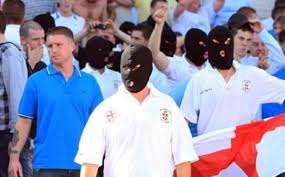
The right-wing group said about 3,000 members would march on 9 October.
But Leicestershire Police said the plans posed a "major threat to public order", with intelligence suggesting a mosque would be attacked.
The EDL said it had no plans to target a mosque and the public "should not be worried". The Home Office will now decide whether to enforce a ban.
Concerns about the impact of the march, and a counter-demonstration by Unite Against Fascism (UAF), were outlined in a letter by Simon Cole, chief constable of Leicestershire Police.
Mr Cole said he believed the rally would attract about 5,000 people from the two organisations.
In August, Home Secretary Theresa May imposed a ban on a planned EDL march in Bradford.
However, the group was allowed to hold a static rally, during which a number of skirmishes broke out between members of the group and rival protesters from UAF.
On its website, EDL said: "We have organised a series of peaceful protests across the country. Unfortunately, some of these have been disrupted... we wish to avoid clashes and putting officers, our members and the public at risk."
The Home Secretary is expected to decide whether to ban Leicester's rally next week.
BBC News
Malaysia rapper's anti-racism rant causes storm

Wee Meng Chee, 27, better known as Namewee to his fans, was hauled in for a police grilling last month over the clip which saw him accused of stirring up ethnic tensions -- a taboo in a country where race is a sensitive issue.
In the three-minute rap titled "Nah", Wee used obscene language to bitterly criticise a Muslim Malay headmistress who is accused of making racial slurs against her ethnic Chinese and Indian students.
"My purpose is to stand up against racism," insisted the flamboyant rapper, who sports a beanie hat and baggy shorts, and who has developed a cult following among young Malaysians who have a growing political awareness.
His official Facebook page has more than 340,000 followers, and his songs have had more than 600,000 hits on YouTube.
"Regardless of what I did was right or wrong, whether you like it or not, I am just giving you an extra choice -- you can choose not to watch it," Wee said.
The rapper, who began writing songs at 15 and graduated with a mass communications degree from a Taiwanese university, first made national headlines in 2007 over another YouTube clip mocking the national anthem.
Authorities condemned the performance as seditious, and pulled him in for what would be the first of three police interrogations during his short career.
The parody touched on abuse of power, corruption, government bureaucracy and controversial positive discrimination policies designed to advance Muslim Malays who dominate the population.
Wee apologised for that incident, and escaped charges.
But last year he ran into more trouble over a song in which he criticised the national power firm over frequent power outages in his hometown in the southern state of Johor.
His latest clip "Nah", which authorities also said was seditious, prompted criticism including from the prime minister who warned of tough action against those who try to provoke racial tensions.
Elements in the ruling party, the United Malays National Organisation (UMNO), called for his citizenship to be revoked and for the rapper to be held under internal security laws that allow for detention without trial.
"He cannot be let off the hook again," Rosnah Abdul Rashid Shirlin, the chief of UMNO's young women's wing who first made the complaint over the "Nah" video, reportedly said at the time.
"We regret that whenever the Malays talk about their rights, they are described as racist but at the same time the non-Malays are free to say anything," she said, calling for a tough response to act as a deterrent to others.
Wee, who would face up to three years in jail if the authorities pursue sedition charges, insists he has done nothing wrong.
"We should be able to speak up and not keep quiet when we have to deal with injustice," he said.
The headmistress he targeted in the video clip was accused of telling her ethnic Chinese students to return to China and compared Hindu prayer strings to dog leashes -- allegations that unleashed a furore.
The government has ordered a probe into the case but no action has been taken against her yet, angering Malaysia's minorities, who complain their rights are being eroded as the country becomes increasingly "Islamised".
Despite the popularity of his cause, Wee has received mixed reviews from commentators who object to the abusive language and boastful comments alluding to the ethnic Chinese community's economic success.
But he has also received applause for daring to tackle head-on an issue that many in Malaysia -- which suffered deadly racial riots in the 1960s -- are too nervous to broach.
"Malaysia should be a country that treats everyone fairly, regardless of their different background," said Wee, who is working on a film about national unity.
"Don't be afraid, because we are paying the government to work for us. Put it in simple terms, we are their boss, they are our servants."
AFP
Saturday, 25 September 2010
Police accused of helping Bogota neo-Nazis (Colombia)
Youth organizations, supported by a local politician, say that policemen are helping violent neo-Nazis in a Bogota neighborhood, a charge denied by police.
Jaime Caicedo, council member in the Fontibon neighborhood, told local radio station Santa Fe that neo-Nazis have attacked people in Fontibon on several occasions. These assaults are not fights between youths, but well-planned attacks carried out for political reasons, the politician said. Caicedo supports claims by local youth organizations that the police are complicit in the violence.
According to Caicedo, the purpose of the attacks is to silence public protest against abuse and intimation by members of the "Third Force", a local neo-Nazi gang.
On September 14 and 15, when the attacks took place, the police not only took 40 minutes to arrive but also neglected to arrest the attackers or seize the weapons used to beat up two boys, the council member told newspaper El Espectador.
"The local police commander threatened several of those assaulted, warning them not to meet in the 'Parque Fundacional' of Fontibon, a place which has turned into a meeting point for citizens that resist the criminal acts of the neo-Nazi gang members," Caicedo said.
Bogota's metropolitan police rejected the allegations as "completely false."
"There is not one report of fights or physical aggression reported on these dates," said police Colonel Hernandez Aldana.
Colombia Reports
Meet the Polish neo-Nazi skinhead couple who discovered they are JEWISH - and turned their lives around

The one-time skinheads grew up as part of a hate-filled white power gang in Warsaw, the capital of Poland and once the site of the largest Jewish ghetto in Nazi-occupied Europe.
But now they are devout members of an Orthodox Jewish synagogue.
The truth about their roots had been buried by their parents to escape persecution from first the Germans and then the Soviet-controlled post-war government.
Even when the couple started spewing anti-Semitic slogans and attacking Jews, their parents still kept silent about their heritage.
Pawel and Ola – who asked for only their first names to be used in a CNN documentary on their story - met at school when they were twelve and married at eighteen.
By then they were heavily involved in the neo-Nazi movement that was rife in Warsaw’s concrete jungle housing estates.
Just 350,000 Jews remained in Poland after the war, a tenth of the population from before the Holocaust, and many fled in the quarter of a century that followed.
For those that remained, parents often decided it better to keep their true faith a secret.
But Ola remembered something her mother once let slip about her Jewish heritage.
And when she checked at Poland’s Jewish Historical Institute she learned the truth – that not only was she a Jew, but so was her husband.
She told CNN of her shock. ‘Something told me to do it. It was unbelievable.
'It turned out that we had Jewish roots. It was a shock. I didn't expect to find out that I had a Jewish husband.'
She said she did not know how to tell Pawel the truth.‘I didn't know how to tell him. I loved him even if he was a punk or skinhead, if he beat people up or not.'
When she did, a disbelieving Pawel confronted his parents.
He said he had been a skinhead and a nationalist '100 per cent'. 'It was all about white power and I believed Poland was only for Poles. That Jews were the biggest plague and the worst evil of this world,' he told CNN
It was difficult to describe the emotions he felt at learning he was Jewish, he said.
‘My first thought was what am I going to tell people? What am I going to tell the boys? Should I admit it or not? I was angry, sad, scared, unsure.’
He was unable to look in the mirror, he said, because he hated what he saw - a Jew.
But as he came to terms with his identity he approached Chief Rabbi of Poland Michael Schudrich, who became a mentor to the couple.
Pawel, now 33, added that he does have regrets - 'but it's not something that I walk around and lash myself over'.
'I feel sorry for those that I beat up but I don't hold a grudge against myself,' he explained. 'The people who I hurt can hold a grudge against me.’
Today, the couple are active members of the Jewish community in Warsaw.
Pawel is studying to work in a slaughterhouse killing animals according to the Jewish Kosher requirement and Ola is working in the synagogue's kitchen as a kosher supervisor.
Rabbi Shudrich paid tribute to them for having the courage to turn their lives around.
‘The fact that they were skinheads actually increased the amount of respect I have for them,’ he said to CNN.
‘That they could've been where they were, understood that that was not the right way, then embraced rather than run away the fact that they were part of the people who they used to hate.
‘I think also it says on a personal level, never write somebody off. Where they may be 10 years ago doesn't have to be where they are today.
And the human being has this unlimited capability of changing and sometimes even for the better,’ he added.
The white power skinhead revival in the seventies and eighties became closely identified with racist and anti-Semitic attacks and spread to Europe and parts of North America.
According to a 2007 report by the Anti-Defamation League, skinhead groups have becoming more active in the U.S. in recent years, with a particular focus on non-white immigration.
Daily Mail
‘Wanted’ faces of EDL rally in Dudley are released (UK)
 These are the faces of 22 men police want to trace after violence broke out following a controversial protest in Dudley.
Detectives investigating reports of criminal damage and disorder in the town centre have today released CCTV images in a bid to identify the men.
Around 600 English Defence League followers descended on the town for a rally on July 17 bringing the centre to a standstill.
Houses and cars were damaged, missiles were hurled at officers and steel fences were pulled down as trouble flared between demonstrators and police.
Shops were boarded up, the market cancelled and roads closed in preparation for the arrival of protestors from across the country.An event hosted by the Dudley Interfaith Alliance was also held on the same day in another part of the town.
Police said today 20 offences had been recorded to date, including criminal damage caused to cars and premises as well as pockets of disorder. Home in Alexandra Street, cars parked in roads surrounding Stafford Street, restaurants in Wolverhampton Street and the Hindu Temple were all attacked by vandals.
Windows were smashed and damage was caused to fencing while a number of vehicles were also targeted as they were being driven through the town.
Detective Inspector Carl Southwick from Force CID, who is leading this investigation, said: “We are appealing to members of the public to look closely at these images. If you recognise any of these individuals or believe you have information that may help, I urge you to come forward.
“We are committed to identifying those responsible for the pockets of disorder and criminal damage that took place in Dudley town centre that afternoon.”
Anybody who recognises the men, or who witnessed anything in the area at the time is asked to contact West Midlands Police – Force CID, Operation Belvedere on 0121 428 6123 or 0345 113 5000. People can also call Crimestoppers anonymously on 0800 555 111.
The cost of policing the protest was £400,000 with money being spent on pay for officers, whose rest days were rearranged so they would be available for duty.
It was also used on specialist policing teams such as the dog handlers and operational support units. The English Defence League said it was demonstrating against a planned £12million mosque in Hall Street, Dudley.
Express and Star
Police fear protesters plan to attack Leicester mosque (UK)
Police fear protesters plan to attack a city mosque before marching into the heart of Leicester's Muslim community.
Concerns were voiced by Chief Constable Simon Cole in a report to Leicester City Council about the planned march by the English Defence League on October 9.
The Chief Constable said that an intelligence and threat assessment indicated a "major threat" to public order.
His report said: "Intelligence dated September 8, 2010, indicated that the EDL intend to come to Leicester and attack a mosque before marching into the Highfields area, which represents the highest resident population of the Muslim community.
"This reflects previous intentions of EDL processions, such as that within Leicester, where actions were targeted to cause disruption to the Muslim community by provoking serious public disorder."
Leicester City Cabinet yesterday agreed to apply to the Home Office to ban the planned procession under the Public Order Act 1986.
However, the EDL, in a statement, rejected the police claims.
EDL event organiser Guramit Singh said: "We are coming to Leicester to peacefully demonstrate and we denounce attacks on any mosques. We are here to fight militant Islam, not moderate Islam. The intelligence provided by the police is incorrect."
The EDL submitted an application to march through the city to police this week. United Against Fascism has applied to hold a counter-demonstration on the same day.
Up to 5,000 people could take part in the rival protests.
If the Home Office agrees to ban the EDL march, the group could still hold a static protest, which the authorities would be powerless to prevent taking place.
Muslim groups said they were concerned by the police intelligence reports.
Suleman Nagdi, chairman of the Federation of Muslim Organisations, said: "An attack on a place of worship is an attack on us all, the relationship and resilience among Leicester's faith communities is very strong and we are confident that this will not break our unity."
Ibrahim Mogra, associate Imam at Evington Muslim Centre, said: "The news of a planned attack is very worrying. There have been a number of mosques up and down the country that have suffered attacks at the hands of far-right groups. Everything possible needs to be done to prevent that."
Speaking after the meeting, city council leader Veejay Patel said the council was determined to secure a ban on the march.
He said: "The evidence we are now able to put to the Home Secretary shows overwhelmingly that this march will bring massive disruption – and possibly violence – to Leicester, and therefore it should not be allowed to take place."
The city's three MPs, who were present at yesterday's meeting, said in a joint statement: "The EDL cannot and will not affect Leicester's long and proud history of community cohesion which the city council, voluntary, community and faith groups, local public services and businesses have all worked hard to build and maintain."
After the meeting, Leicester East MP Keith Vaz said: "I have directly contacted the Home Secretary Theresa May to emphasise the strength of feeling here in our city. All three Leicester MPs will be lobbying her directly on this issue."
Leicester West MP Liz Kendall said: "It is a massive decision to attempt to ban a group's right to protest, but it's the only option available."
In a report on the proposed English Defence League march in Thursday's Leicester Mercury, we reported that campaign group Hope Not Hate was planning a counter demonstration.
We have been asked to point out that Hope Not Hate is, in fact, hoping to hold a peace vigil the night before the proposed EDL protest and is not planning a counter demonstration.
It is also involved in plans for a celebration of the city, which is scheduled to take place a day after the EDL event on Saturday, October 9. We are happy to clarify the situation.
This is Leicester
Guardian Angels Charged With “Hate Crime” (USA)
The fledgling Guardian Angels franchise in Millville, New Jersey was forced to shut down in September of 2009 after several of its members were arrested for their alleged involvement in a “hate crime” attack on a White girl who was dating an African-American boy.
NJ.com reports two adults and a juvenile – James L. Chard, 21, Amanda E. Schemeley, 20, and a 16-year-old Millville girl – were charged in the attack, which happened on either August 20th or 21st.
They are charged with carving racist slurs into the 16-year-old girl’s car and slashing its tires, causing between US$500 – US$2000 in damages.
The Daily Journal reports that Chard and Schemeley were trainees with the Guardian Angels.
Police have also arrested Gilpatrick H. Matos, 26, for allegedly trying to get two of the suspects to recant their statements and give false testimony. Matos was also a member of the Millville franchise.
This was not the first time the Millville franchise had problems. Several dramatic personality conflicts caused the outfit to dwindle down to three members several months prior to the incident.
It was hoped the new trainees would inject new life into the franchise.
The Right Perspective
Hate crime appeal for attack in Southsea (uk)
Between 10pm on Wednesday and 7am yesterday, paint was poured through the letterbox of the victim's front door in Malvern Road, Southsea.
The words 'Irish F Q' were daubed on the front door in paint, a television set was dumped on the front step and more paint poured over it.
The offender also cut the heads off flowers planted in pots outside the woman's front door.
Anyone with information should contact PC Hannah Buckley at Southsea station on 101.
Portsmouth News
Thomas Honeyman hit couple with bar stool in racist attack (uk)
 |
| Thomas Honeyman |
Thomas Honeyman, 21, battered Tracey Mitchell and her husband, Melville, with a bar stool in a pub in Bishop Auckland.
Earlier he had hurled racial and personal insults at Mrs Mitchell as they sat with friends in The Cumberland Arms Hotel, said Richard Bennett, prosecuting.
The couple both needed treatment at Darlington Memorial Hospital after the attack, which left Mr Mitchell with a cut head and his wife with an injured hand after she had tried to protect herself.
Teesside Crown Court was told Honeyman had been sitting at a nearby table on November 1 last year when he began making “rather childish” comments about Mr Mitchell.
Mr Mitchell had an argument with him before returning to his table, and then the couple became aware of Honeyman approaching them at speed carrying a bar stool above his head, which he brought down with some force on them, knocking them both to the floor.
Honeyman ran outside as customers and staff helped the couple.
Police officers found him walking along the street, bare-chested and bleeding from a cut to the head.
He said that he had fallen over, said Mr Bennett.
But Honeyman was later arrested for the attack and claimed Mrs Mitchell had called him a “dirty, stinking gipsy”.
Honeyman was released on police bail, during which he robbed a man walking alone past The Llewellyn pub, in Ferryhill, County Durham. A total of £90 was stolen.
Bryan Russell, defending, said Honeyman admitted he had gone “spectacularly off the rails” in the later part of last year, but while in prison on remand he had taken part in courses to tackle his drink and drug problems.
Judge Peter Bowers told Honeyman that if he had wanted to be harsh he could have sentenced him to six years in jail.
The judge added: “Unfortunately, these two offences do merit sentences of one after the other, but I will reduce them.”
Honeyman, of Chillerton Way, Wingate, County Durham, was jailed for four years after he pleaded guilty to racially-aggravated actual bodily harm, assault and unlawful wounding and to robbery.
The Northern Echo
Friday, 24 September 2010
Sweden Democrat 'members' site shut down
The website on which the leaked Sweden Democrat membership list was published has been shut down by the web hosting company where the domain name was registered.
The site, sverigedemokrater.se, was registered with Swedish web hosting from Binero under the company name of Gottfrid Swartholm Warg, founder of The Pirate Bay.
The site’s content, however, is hosted by PRQ, the same company that hosts Wikileaks.
However, when Binero discovered that Swartholm Warg was in fact not the owner of the account, it shut down the domain and contacted police.
“The web should be free, but no wild west,” Binero founder and CEO Anders Aleborg said in a statement.
“We have fought hard to improve the reputation of the hosting business for years, and whenever we find faulty user information, we act.”
The site went live on September 20th, the day following a stunning electoral performance by the Sweden Democrats which gave them 20 seats in the Riksdag.
It contained personal data, including telephone numbers, email addresses, and maps to the homes of thousands of people who were either members of the Sweden Democrats or had requested information about the party.
The data featured on the site, which had a slogan of “Find a buddy near you“, is believed to have been obtained from an April 16th hacker attack of the Sweden Democrats’ official website.
Binero added that, although PRQ is legal responsible for the content of the site hosted on its servers, Binero is within its rights to shut down the site’s domain if there are suspicions of false user information, which amounts to a breach of contract.
The Local Se
MTV, Magyar Rádió block Jobbik ads (Hungary)
Magyar Rádió has refused to broadcast Jobbik's party political broadcasts, saying this would be tantamount to a covert offending of the Roma minority.
"MTV did not even bother to inform Jobbik that the election advertisement will not be broadcast on Thursday," party spokeswoman Dóra Dúró told the Independent News Agency. "Jobbik uses the term Gypsy crime in the criminological sense of the word, not in the ethnic one," she added.
Jobbik will now appeal to the National Election Commission because two state-run media outlets are impeding the dissemination of the party's political views, Dúró said.
MTV later said in a statement that political advertisements must meet specifications laid down in the respective legal regulations and Jobbik's advertisement does not meet those requirements as it contains misleading claims and violates privacy rights.
Politics Hu
Subscribe to:
Posts (Atom)